Cliché Collection
Cliché Collection
An independent experiment in redefining luxury, testing craftsmanship and listening to the market.
Designer / Entrepreneur
Questioning the Language of Value
In the 2010s, many designer friends around me were creating jewellery that I found highly contemporary, intelligent and beautifully resolved. At the same time, I noticed a contradiction in the market. On one side, semi-precious materials, inexpensive materials and even waste could be transformed through design into jewellery with considerable creative value. On the other, major jewellery brands were working with gold and diamonds yet often producing pieces that remained conventional and stylistically familiar.
This led me to a simple question: What would happen if precious materials were treated with the same contemporary design ambition?
That question became the starting point for the Cliché Collection. Cliché was an independent project, so I was responsible not only for the design but also for taking the collection through production, launch and ultimately the decision to withdraw it from the market.
Abstracting the Familiar
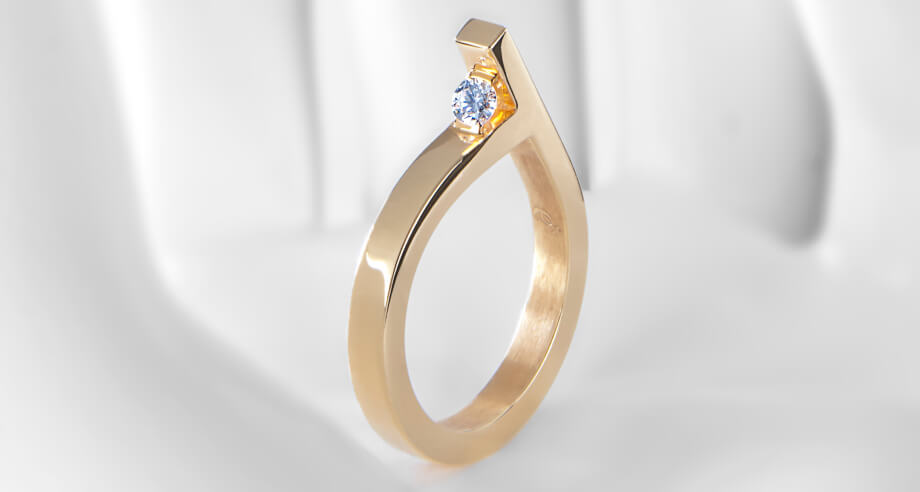
I deliberately began with some of jewellery's most familiar and perhaps overused symbols: the solitaire ring, the three-stone setting, the heart and other recognisable archetypes. Instead of rejecting these clichés, I tried to reduce them to their geometric essence.
The forms gradually became more abstract, precise and minimal. Gold and diamonds remained central, but the visual language was stripped of ornament and sentimentality. At the time, the results felt unusually restrained and perhaps even too modern for the category.
The collection was not questioning the value of precious jewellery. It was questioning how that value could be expressed. Could proportion, geometry and precision replace complexity and decoration as signals of quality?
When Simplicity Becomes Difficult
Production took place with craftsmen in Istanbul's Grand Bazaar who were accustomed to working for established jewellery houses. When they first saw the drawings, some seemed almost amused by their simplicity. They were used to producing highly elaborate pieces and expected the reduced geometric forms to be relatively straightforward. The opposite proved true.
Pieces initially expected within three months took five months to complete. Eventually, the craftsmen explained why: pure geometry allowed almost no tolerance for error. A slightly incorrect angle, proportion or surface immediately became visible. Several pieces had to be remade from the beginning.
This became one of the most valuable outcomes of the project. Formal simplicity had pushed craftsmanship towards greater precision. The collection was therefore not only an aesthetic experiment. It tested both what traditional jewellery production could achieve with a radically reduced formal language and how the market might respond to a different expression of luxury.
Design, Market and the Right to Experiment
The collection was eventually presented at the Nişantaşı jewellery store of my friends Ela Cindoruk and Nazan Pak, who generously hosted both the pieces and the launch. At that point, I was confident we had created something meaningful. I liked the work, and the difficulties encountered in production had strengthened my belief in it. Three months later, almost nothing had sold. I withdrew the collection.
That experience was uncomfortable but important. Perhaps some products do not exist because there is simply no demand for them. But design cannot always know this before testing the idea.
If every design project begins only with proven demand, design can do little more than reproduce what the market already understands.
Cliché became a lesson in both ambition and humility: push materials, craftsmanship and conventions when there is a meaningful question to explore but remain prepared for the market to answer differently. Commercial success is one form of validation; understanding the boundaries of acceptance is another. The market had answered, and the answer was useful. Innovation needs room for experiments whose value may sometimes be learning rather than immediate sales.